Lesson 8: Software Automation
Machine Learning & Artificial Intelligence
📖 Introduction
Software automation uses Machine Learning (ML) and Artificial Intelligence (AI) to automate repetitive tasks, make predictions, and enable intelligent decision-making.
- Automation: DevOps, RPA, BPA
- AI: Broad concept of intelligent machines
- ML: Subset of AI that learns from data
- Training: Supervised, unsupervised, reinforcement learning
🔧 How ML Supports Automation
1. DevOps (Development + Operations)
ML automates integration between software development and IT operations.
- Continuous Integration/Deployment (CI/CD): Automated testing, build processes, deployment
- Anomaly Detection: Identify system failures before they occur
- Log Analysis: Parse millions of log entries to find errors
- Resource Optimization: Predict server load, auto-scale infrastructure
- Code Review: ML models suggest improvements, detect bugs
Example: GitHub Copilot uses ML to suggest code completions based on context.
2. RPA (Robotic Process Automation)
Software "robots" automate repetitive, rule-based tasks.
- Data Entry: Extract data from invoices, enter into databases
- Email Processing: Read emails, categorize, send automated responses
- Report Generation: Compile data from multiple sources, create reports
- Customer Onboarding: Verify documents, create accounts, send welcome emails
- Payroll Processing: Calculate wages, deductions, generate payslips
Tools: UiPath, Automation Anywhere, Blue Prism
3. BPA (Business Process Automation)
Automates complex business workflows involving multiple systems and decisions.
| Aspect | RPA | BPA |
|---|---|---|
| Scope | Individual repetitive tasks | End-to-end business processes |
| Complexity | Simple, rule-based | Complex workflows with decision logic |
| Example | Copy data from email to spreadsheet | Complete order fulfillment (order → payment → shipping → notification) |
| Integration | Surface-level (UI interaction) | Deep (API, database integration) |
🤖 Artificial Intelligence vs Machine Learning
- AI (Artificial Intelligence): Broad concept of machines performing tasks that typically require human intelligence (reasoning, learning, problem-solving)
- ML (Machine Learning): Subset of AI where machines learn from data without explicit programming
Analogy: AI is the goal (intelligent machines), ML is the method (learning from data to achieve intelligence).
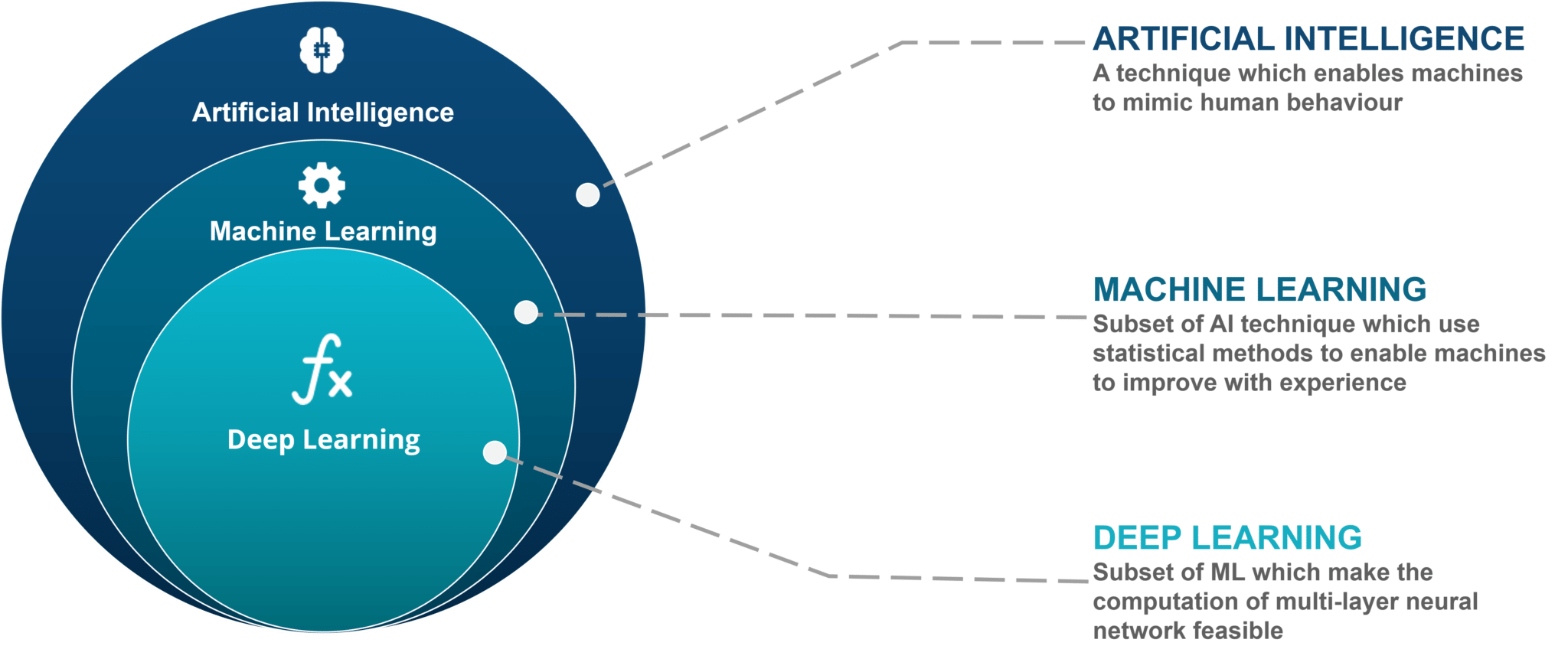
Visual Hierarchy: AI encompasses ML, which encompasses Deep Learning.
Source: Edureka
AI (broader category):
- Chess-playing program (rule-based AI, not necessarily ML)
- Self-driving cars (combines ML, computer vision, robotics)
- Virtual assistants (Siri, Alexa) - combines ML, NLP, speech recognition
ML (specific technique within AI):
- Spam email filter (learns from labeled spam/not spam examples)
- Product recommendations (learns from purchase history)
- Image recognition (learns from labeled images)
| Aspect | Traditional Programming | Machine Learning |
|---|---|---|
| Approach | Programmer writes explicit rules | Algorithm learns patterns from data |
| Adaptability | Fixed rules, must manually update | Adapts as new data arrives |
| Example | "If email contains 'FREE MONEY', mark as spam" | "Learn which patterns indicate spam from 10,000 examples" |
| Limitation | Cannot handle unpredictable inputs | Requires large datasets, may be biased |
🎓 Training Machine Learning Models
ML models learn by analyzing data. Training method depends on data type and problem.
1. Supervised Learning
Learn from labeled data (input-output pairs). Model learns mapping from inputs to outputs.
Training Data (labeled):
- "Congratulations! You won $1M!" → Spam
- "Meeting tomorrow at 2pm" → Not Spam
- "Click here for FREE iPhone!" → Spam
- "Your order #12345 has shipped" → Not Spam
Process:
- Feed 10,000 labeled emails to model
- Model learns patterns (e.g., "FREE", "Click here", excessive punctuation = likely spam)
- Test on new, unseen emails
- Model predicts: spam or not spam
Common Applications: Image classification, fraud detection, medical diagnosis, price prediction
2. Unsupervised Learning
Learn from unlabeled data. Model finds hidden patterns without being told what to look for.
Training Data (unlabeled):
- Customer 1: Age 25, Income $40K, Buys tech gadgets
- Customer 2: Age 55, Income $80K, Buys gardening tools
- Customer 3: Age 28, Income $45K, Buys tech gadgets
- Customer 4: Age 60, Income $75K, Buys gardening tools
Process:
- Feed customer data (no labels like "Group A" or "Group B")
- Model clusters similar customers together
- Discovers: Group 1 (young, tech-focused), Group 2 (older, gardening-focused)
- Business uses segments for targeted marketing
Common Applications: Market segmentation, anomaly detection, data compression, recommendation systems
3. Semi-Supervised Learning
Mix of labeled (small amount) and unlabeled (large amount) data.
Labeling data is expensive and time-consuming. Semi-supervised uses small labeled dataset to guide learning on large unlabeled dataset.
Example: You have 100 labeled medical images (cancer/not cancer) and 10,000 unlabeled images. Model uses the 100 labeled to learn patterns, then applies to 10,000 unlabeled.
4. Reinforcement Learning
Learn through trial and error with rewards/penalties. Agent takes actions in environment, receives feedback.
Scenario: Training AI to play chess
- Agent: AI chess player
- Environment: Chess board and game rules
- Actions: Legal chess moves
- Reward: +1 for winning, -1 for losing, 0 for draw
Process:
- AI makes random moves initially (exploration)
- Receives rewards based on outcomes
- Learns which moves lead to wins (exploitation)
- Over thousands of games, improves strategy
Real-World Applications: Self-driving cars, robotics, game AI (AlphaGo), resource management
| Learning Type | Data Type | Use Case | Example |
|---|---|---|---|
| Supervised | Labeled (input + output) | Prediction, classification | Email spam filter |
| Unsupervised | Unlabeled (input only) | Pattern discovery, clustering | Customer segmentation |
| Semi-Supervised | Small labeled + large unlabeled | When labeling is expensive | Medical image analysis |
| Reinforcement | Feedback from actions | Sequential decision-making | Game AI, robotics |
📱 Common Machine Learning Applications
1. Data Analysis and Forecasting
- Sales Prediction: Forecast revenue based on historical data
- Stock Market Analysis: Predict price movements (high risk, limited accuracy)
- Weather Forecasting: Predict temperature, precipitation from sensor data
- Demand Forecasting: Optimize inventory (e.g., supermarket stock levels)
2. Virtual Personal Assistants
- Siri, Alexa, Google Assistant: Natural Language Processing (NLP) to understand voice commands
- Speech Recognition: Convert audio to text
- Intent Recognition: Understand user intent ("Set alarm for 7am" → create alarm)
- Context Awareness: Remember previous conversations
3. Image Recognition
- Facial Recognition: Unlock phones, security systems, tagging photos
- Object Detection: Self-driving cars identify pedestrians, traffic signs, vehicles
- Medical Imaging: Detect tumors in X-rays, MRI scans
- Quality Control: Manufacturing defect detection
- Content Moderation: Detect inappropriate images on social media
Combines multiple ML techniques:
- Computer Vision: Identify pedestrians, lanes, traffic lights
- Sensor Fusion: Combine camera, LIDAR, radar data
- Path Planning: Determine optimal route
- Decision Making: When to brake, accelerate, change lanes
- Reinforcement Learning: Improve driving through simulation
Companies: Tesla, Waymo, Cruise
🌳 Machine Learning Design Models
1. Decision Trees
Flowchart-like structure for making decisions based on feature values.
Is it raining?
├── Yes → Don't play tennis
└── No → Is it windy?
    ├── Yes → Is temperature > 25°C?
    │   ├── Yes → Play tennis
    │   └── No → Don't play tennis
    └── No → Play tennis
How it works:
- Start at root (top question)
- Follow branches based on answers
- Reach leaf node (final decision)
Advantages: Easy to understand, visualize, explain to non-technical people
Disadvantages: Can overfit (memorize training data), unstable (small data changes = big tree changes)
2. Neural Networks
Brain-inspired networks of interconnected nodes (neurons) that process information in layers.
Layers:
- Input Layer: Receives raw data (e.g., pixel values of image)
- Hidden Layers: Process and transform data (multiple layers = "deep learning")
- Output Layer: Produces final prediction (e.g., "cat" or "dog")
How it learns:
- Feed training data through network
- Compare output to correct answer
- Adjust connection weights (backpropagation)
- Repeat thousands of times until accurate
Use Cases: Image recognition, speech recognition, language translation, game AI (AlphaGo), autonomous vehicles
Advantage: Can learn extremely complex patterns
Disadvantage: Requires massive data and computing power, "black box" (hard to explain why it made a decision)
| Model | Best For | Pros | Cons |
|---|---|---|---|
| Decision Trees | Simple classification, interpretable decisions | Easy to understand, fast, works with small data | Overfits, unstable, limited accuracy on complex problems |
| Neural Networks | Complex patterns (images, speech, text) | Highly accurate, handles complex data | Needs large data, slow to train, black box |
📊 Common Machine Learning Algorithms
1. Linear Regression
Predicts numeric values assuming linear relationship between input and output.
from sklearn.linear_model import LinearRegression
import numpy as np

# Training data: house size (sqft) → price ($)
sizes = np.array([[1000], [1500], [2000], [2500], [3000]])
prices = np.array([200000, 300000, 400000, 500000, 600000])

# Create and train model
model = LinearRegression()
model.fit(sizes, prices)

# Predict price for 1800 sqft house
prediction = model.predict([[1800]])
print(f"Predicted price: ${prediction[0]:,.0f}") # Output: ~$360,000- Real Estate: Predict house prices from size, location, bedrooms
- Sales Forecasting: Predict revenue from advertising spend
- Risk Assessment: Predict insurance premiums from age, health
- Supply Chain: Predict delivery time from distance, traffic
Limitation: Only works when relationship is linear (straight line). Real-world data often nonlinear.
2. Logistic Regression
Binary classification (yes/no, true/false, 0/1 predictions).
from sklearn.linear_model import LogisticRegression
import numpy as np

# Training data: study hours → pass/fail
hours = np.array([[1], [2], [3], [4], [5], [6], [7], [8]])
passed = np.array([0, 0, 0, 1, 1, 1, 1, 1])  # 0=fail, 1=pass

# Create and train model
model = LogisticRegression()
model.fit(hours, passed)

# Predict: Will student pass if they study 3.5 hours?
prediction = model.predict([[3.5]])
probability = model.predict_proba([[3.5]])[0][1]

print(f"Prediction: {'Pass' if prediction[0] == 1 else 'Fail'}")
print(f"Probability of passing: {probability:.2%}") # e.g., 67%- Medical Diagnosis: Disease present or not (based on symptoms, test results)
- Credit Approval: Approve or deny loan application
- Email Filtering: Spam or not spam
- Customer Churn: Will customer cancel subscription?
3. K-Nearest Neighbors (KNN)
Classifies based on proximity to training data. "You are the average of your K closest neighbors."
Scenario: Recommend movies based on what similar users liked
Process (K=3):
- User A likes: Action, Sci-Fi, Thriller
- Find 3 most similar users (B, C, D) based on preferences
- User B liked "Inception" → User A might like it too
- Users C and D both liked "The Matrix" → Recommend "The Matrix"
How K affects results:
- K=1: Very sensitive to outliers, may overfit
- K=100: Too general, ignores local patterns
- K=5-10: Often a good balance
| Algorithm | Problem Type | Output | Example |
|---|---|---|---|
| Linear Regression | Regression (numeric prediction) | Continuous number | Predict house price: $350,000 |
| Logistic Regression | Binary classification | 0 or 1 (yes/no) | Email is spam: Yes (1) |
| K-Nearest Neighbors | Classification or regression | Category or number | Movie genre: Action |
🐍 Programming ML Models Using OOP
Object-oriented design makes ML code reusable, maintainable, and testable.
1. Encapsulation
- Bundle data (attributes) and methods together in a class
- Hide internal details, expose only necessary interface
- Example: Model's internal weights hidden, only
train()andpredict()exposed
2. Inheritance
- Create new classes based on existing classes
- Child class inherits attributes and methods from parent
- Example:
HousePricePredictorinherits from baseMLModelclass
3. Polymorphism
- Same method name, different implementations
- Objects of different classes respond to same method call
- Example: Both
LinearRegressionandRandomForesthavepredict()method
4. Abstraction
- Focus on essential features, hide complexity
- Define interface without implementation details
- Example: User calls
predict()without knowing internal math calculations
These principles were covered in detail in Lesson 3. Here we apply them to machine learning!
class HousePricePredictor:
    """Predicts house prices using linear regression."""

    def __init__(self):
        from sklearn.linear_model import LinearRegression
        self.model = LinearRegression()
        self.is_trained = False

    def train(self, sizes, prices):
        """Train model on house sizes and prices."""
        self.model.fit(sizes, prices)
        self.is_trained = True
        print(f"Model trained on {len(sizes)} examples")

    def predict(self, size):
        """Predict price for given house size."""
        if not self.is_trained:
            raise ValueError("Model not trained yet!")

        prediction = self.model.predict([[size]])[0]
        return round(prediction, 2)

    def evaluate(self, test_sizes, test_prices):
        """Calculate model accuracy on test data."""
        from sklearn.metrics import r2_score
        predictions = [self.predict(size[0]) for size in test_sizes]
        score = r2_score(test_prices, predictions)
        return score

# Usage
predictor = HousePricePredictor()

# Training data
train_sizes = [[1000], [1500], [2000], [2500]]
train_prices = [200000, 300000, 400000, 500000]

predictor.train(train_sizes, train_prices)

# Make predictions
price = predictor.predict(1800)
print(f"Predicted price for 1800 sqft: ${price:,.0f}")

# Evaluate on test data
test_sizes = [[1200], [2200]]
test_prices = [240000, 440000]
accuracy = predictor.evaluate(test_sizes, test_prices)
print(f"Model accuracy (R²): {accuracy:.2%}")- Encapsulation: Hide model complexity, expose simple interface
- Reusability: Create once, use in multiple projects
- Inheritance: Extend base model for specialized use cases
- Polymorphism: Swap different models (LinearRegression → RandomForest) without changing code
- Testability: Unit test train(), predict(), evaluate() methods separately
🌍 Impact of Automation on Society
Positive Impacts
1. Worker Safety Improvements
- Dangerous Tasks: Robots handle hazardous materials, extreme temperatures, toxic environments
- Repetitive Strain: Automation reduces injuries from repetitive motions
- Heavy Lifting: Machines prevent back injuries, muscular damage
- Example: Manufacturing robots weld, paint, assemble in conditions unsafe for humans
2. Support for People with Disabilities
- Screen Readers: AI reads web content aloud for visually impaired
- Voice Control: Operate devices hands-free
- Predictive Text: Faster communication for motor impairments
- Prosthetics: ML-controlled artificial limbs
- Captioning: Auto-generated subtitles for hearing impaired
3. Production Efficiency
- 24/7 Operation: Machines don't need breaks, sleep
- Consistency: Uniform quality, fewer defects
- Speed: Faster than human workers
- Waste Reduction: Precision reduces material waste
- Energy Efficiency: Optimized resource usage
Negative Impacts
1. Employment Disruption
- Job Displacement: Automation replaces human workers (manufacturing, data entry, customer service)
- Skill Requirements: Jobs shift from manual to technical (programming, maintenance)
- Wage Pressure: Reduced demand for low-skill labor decreases wages
- Geographic Impact: Factory towns lose primary employment source
Self-driving trucks threaten 3.5 million truck driver jobs in the US. While safer and more efficient, massive retraining needed for displaced workers.
Question: Who pays for retraining? What happens to small towns dependent on trucking?
2. Wealth Distribution
- Capital Concentration: Automation benefits owners, not workers
- Income Inequality: High-skill workers prosper, low-skill workers struggle
- Economic Gap: Wealth concentrates in tech-heavy regions (Silicon Valley, Seattle)
- Proposed Solutions: Universal Basic Income (UBI), robot taxes, retraining programs
3. Environmental Effects
- Energy Consumption: Data centers training AI models use massive electricity
- E-Waste: Rapid technology obsolescence creates electronic waste
- Resource Extraction: Rare earth minerals for electronics (environmental damage)
- Positive: Optimized logistics reduce fuel consumption, smart grids reduce energy waste
| Impact Area | Positive | Negative |
|---|---|---|
| Employment | New tech jobs, safer working conditions | Job displacement, skill mismatch |
| Economy | Increased productivity, lower costs | Income inequality, wealth concentration |
| Accessibility | Tools for disabled, elderly, remote areas | Digital divide (access gap) |
| Environment | Optimized resource use, reduced waste | Energy consumption, e-waste |
⚖️ Dataset Bias and Ethical Considerations
Understanding Bias in AI/ML
ML models learn from data. If training data is biased, the model will be biased.
Fundamental Rule: Machine learning models reflect the data they're trained on. Biased data → biased decisions.
Types of Bias
1. Historical Bias
Data reflects historical discrimination and inequalities.
Scenario: Company trains ML model to screen job applicants
Training Data: Resumes of past successful hires (mostly men in tech roles)
Result: Model learns to favor male applicants, penalizes female applicants
Why: Historical data reflects past discrimination, model amplifies it
Real Case: Amazon scrapped hiring AI in 2018 for gender bias
2. Representation Bias
Training data doesn't represent population diversity.
Problem: Facial recognition models trained mostly on white faces
Result: Higher error rates for people of color (false positives in security systems)
Study: MIT found some systems had 0.8% error for white males, 34% error for dark-skinned females
Solution: Diverse, representative training datasets
3. Measurement Bias
Features used for training are poor proxies for what we want to measure.
System: COMPAS (predicts if criminal will reoffend)
Problem: Uses arrest history as proxy for criminality
Bias: Black defendants flagged as high-risk twice as often as white defendants (similar crimes)
Why: Arrest rates reflect policing bias, not actual crime rates
Impact: Longer sentences, denied parole for biased predictions
Ethical Principles for AI/ML
- Fairness: Ensure equal treatment across demographics (age, gender, race)
- Transparency: Explain how model makes decisions (no "black boxes")
- Accountability: Identify who is responsible when AI causes harm
- Privacy: Protect user data, obtain informed consent
- Safety: Test rigorously before deployment, especially in critical systems (healthcare, criminal justice)
- Human Oversight: Humans make final decisions in high-stakes scenarios
Cultural and Psychological Considerations
Cultural Protocols and Belief Systems
- Language Barriers: NLP models trained on English perform poorly on other languages
- Cultural Norms: Sentiment analysis misinterprets sarcasm, idioms across cultures
- Religious Beliefs: Medical AI must respect cultural attitudes toward treatment
- Example: Translation AI mistranslates cultural context (formal vs informal language)
Psychological and Stress Response Patterns
- Mental Health AI: Chatbots for therapy must handle crisis situations appropriately
- Emotion Recognition: AI interpreting facial expressions may misread cultural differences
- Stress Detection: Workplace monitoring raises privacy concerns
- Addiction Algorithms: Social media AI maximizes engagement, may harm mental health
ML is a powerful tool, but not neutral. Developers must actively work to identify and mitigate bias. Data scientists have ethical responsibility to build fair, transparent, accountable systems.
📝 Lesson Summary
- Automation: DevOps (CI/CD, anomaly detection), RPA (task automation), BPA (workflow automation)
- AI vs ML: AI = intelligent machines (broad), ML = learning from data (specific technique)
- Training Models: Supervised (labeled), unsupervised (unlabeled), semi-supervised (mix), reinforcement (rewards)
- Applications: Data forecasting, virtual assistants, image recognition, self-driving cars
- Design Models: Decision trees (flowchart), neural networks (brain-inspired)
- Algorithms: Linear regression (numeric), logistic regression (binary), K-nearest neighbors (similarity)
- OOP in ML: Encapsulation, reusability, inheritance for ML models
- Impact: Positive (safety, accessibility, efficiency), Negative (job displacement, inequality)
- Ethics: Dataset bias, fairness, transparency, accountability, cultural sensitivity
- Distinguish AI (broad) from ML (learns from data)
- Know training types: supervised needs labels, unsupervised finds patterns
- Explain bias: biased training data → biased AI decisions
- Describe impact: job displacement vs new opportunities
- Give real examples: spam filter (supervised), customer segmentation (unsupervised)
You've completed all 8 theory lessons. Focus now on coding practice and review. Good luck on the HSC exam!